
The Persian Cat

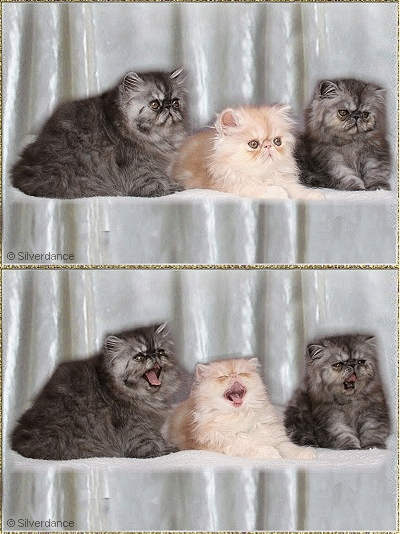
There is no proven theory as to the origin of the Persian cat. It is maintained that at the end of the 16th Century it was discovered in Ankara, Turkey. For a long time they were known as Angorian cats. Other theories consider Persia as the country of origin and therefore for many years they have been called Persians. Researchers think that they descended from wild long hair cats, e.g. the Manul which developed its long hair as a natural protection against winter cold weather in the mountains around Ankara. Which brings us back to Turkey!
It is maintained through research that the long hair resulted from a mutation and then passed along through natural selection and through breeding programmes designed to ensure that the long hair gene was inherited. As is the case for so many things, the truth will lie somewhere in the middle. In the last century the Persian cat was exhibited at shows in England for the first time. Their popularity soon spread throughout the world. Besides the Siamese, the Persian is the most well-known breed in the world. The first Persians were black and white. The colours blue, cream and red were soon to follow.
The Persian standard calls for a round head as an apple, small rounded ears set well apart and full cheeks. The eyes are large and round and with a few exceptions the standard calls for the eyes to be of an Orange or Copper colour. The nose should be short and strong Stop. The upper edge of the nose should complete at least the lower eye border, optimal is, the upper edge of the nose lies in the position of middle of the eyes.
A compact body sits on short, strong legs with round paws. The coat is long and silky. The tail is short and bushy. A break or kink in the tail or a point at the end of the tail is considered a fault. In cat shows, judges would disqualify a cat with faults like these, which would mean no awards. It would also not be advisable to breed a cat with such faults.
The table of color applies not only to solid cats, but also to smoke, shaded, tabby and bicolor cats.
The color code:
CFA ,
FIFE,
WCF,
GCCF,
TICA
The Registration-Code der Cat Federation of South Africa (CFSA) and
Southern African Cat Council (SACC)
The Color-Genetic-Code is available here.
A more detailed summary about the various colors, designs and eye colors can be found here.
Behind
each picture on the left are details of
the respective Cattery which kindly allowed me
to use their pictures. Move the mouse over the
picture to see the name of the cat,
colour, sex, availability and the age of the
cat pictured.
Persians need a longer period to develop to full
growth and for their eye colour to come in, be
it copper or emerald-green.
|
|
Here you can use following HTML Code for your website:
|
Links to the organisations worldwide
Cat Fanciers' Association - CFA Co-Ordinating Cat Council of Australia - CCC of A Fédération Internationale Féline - FIFe Governing Council of the Cat Fancy - GCCF New Zealand Cat Fancy - NZCF Southern African Cat Council - SACC The International Cat Association - TICA World Cat Federation - WCF |
||
|
WCF Standard |
WCF Color distribution |
FIFE in English/German/Français:
Breedstandard
Colour varieties
Colour varieties
Colour varieties |
|
CFA in English: |
TICA in English: |
|
|
ACF in English: |
CCC of A in English: |
|
|
NZCF in English: |
SACC in English: |
|
|
GCCF in English: all about Persians Standard of Points for Persians recognised by the GCCF |
||
The Exotic Longhair results from the mating of Persian and Exotic Shorthair. This designation is only used by the CFA.
SORRY if the English is not perfect ... Thank you to all that you entrusted me your pictures!!! - Cattery Silverdance
| Cattery | Land |
| Ares De Cascais | Portugal |
| Baltic Bay | Denmark |
| Barrakudas | UK |
| Belogorie | Russia |
| Bjonnansen | Norway |
| Blazestar | Brasilia |
| Bodega Bay | Germany |
| Bolshoycat | France |
| Bonne Santé | Germany |
| Castlegate | USA |
| Catpavillon | Germany |
| Cha Cha | South Africa |
| Chatil de Rex | Denmark |
| Chinaponds | Australia |
| Chipendales | Germany |
| Cosydream | Germany |
| Crayola Cats | USA |
| Denspurr | UK |
| Danmoso | UK |
| Duetcatz | USA |
| Earth-2 | Germany |
| Ekapsalis | Greece |
| De L'Emeraude | France |
| Estagel | Germany |
| Fluffygrape | Netherland |
| Invention | Germany |
| Iwanda | Netherland |
| Jay | Thailand |
| Jokercats | Germany |
| Just-4-Fun | Germany |
| Kaikin | USA |
| Katrin´s Pearls | Russia |
| Kikiland | USA |
| Kingdom-Katz | USA |
| Kishtwar | Norway |
| Klippeneck | Germany |
| Kvarndammen | Sweden |
| LacusFelix | Austria |
| Lady Basket´s | Germany |
| Lionstones | Germany |
| Lorcatz | USA |
| Lovely Moon | Germany |
| Me Home | Japan |
| MiraBai | Netherland |
| Miramacats | Germany |
| MisteeRiver | USA |
| Muencheberg | Germany |
| Mystere | UK |
| Nitram | Germany |
| Over The Rainbow | Netherland |
| Pele-Mele | Germany |
| Petovia | Slovenia |
| Persian Passion | Italy |
| Purrbridge | South Africa |
| Purrsatin | Germany |
| Rocawen | UK |
| Roggenstein | Germany |
| Ronjafeld | Germany |
| Royal Ideal | France |
| Sanbach | USA |
| Sepis | Poland |
| Shelby Cat´s | Germany |
| Sherefara | Australia |
| Silverbells | Germany |
| Skybank | Australia |
| Snowbell | Dubai |
| Sublime | Australia |
| Superschmuser | Germany |
| Talshair | UK |
| Tamosah | UK |
| Tiffany´s | Germany |
| Tinafeld | Germany |
| Tukaz | Norway |
| Viana-Fest | Bulgaria |
| Wangalo | Australia |
| Windeacres | New Zealand |